About the Book “Financial Trauma”
A Summary of the Book’s Core Themes, Conceptual Framework, and Practical Implications
By Wendy Molyneux, MSW, CFEI®, wholeperson.finance
Many people carry silent wounds into their financial lives. They try to budget, save, and stay disciplined, yet something keeps pulling them back into the same patterns. In Financial Trauma: Why Money Isn’t Just About Money (2026), Wendy Molyneux explores why those patterns often reflect protective responses shaped by past experiences rather than failures of willpower.
This book explores the psychological and experiential dimensions of money rather than offering one-size-fits-all solutions. Written for general readers and professionals alike, it combines lived experience, research, and practical reflection to make the concepts accessible.
About the Book
The book helps readers shift from self-blame to self-understanding. Instead of asking, “What’s wrong with me?” they begin to ask, “What happened to me? And how is my nervous system trying to protect me?” This reframing alone loosens the shame spiral that keeps so many adults stuck.
Blending neuroscience, trauma theory, and practical financial guidance, the book offers a clear framework for understanding how fight, flight, freeze, and fawn responses show up in money decisions. Readers learn how common financial trauma actually is, why their struggles make sense, and how to identify the patterns—such as avoidance, over-control, rescuing, or risk-seeking—that quietly drive their behavior.
Alongside this self-awareness, the book introduces grounding practices readers can experiment with. Simple breathing practices, pause strategies, and body-awareness techniques help them stay regulated during financial tasks. The book also explores how trauma responses may influence financial conversations with partners.
Over time, readers learn to recognize shame-based cycles, stay within their window of tolerance, set boundaries without guilt, and reconcile financial progress with their upbringing and community. The book also clarifies when deeper support may be needed and what trauma-informed financial therapy looks like.
This work addresses a gap between traditional financial advice and mental health conversations about money. It validates readers’ experiences without leaving them stuck in the past, offering both compassion and a path forward. The ultimate promise is agency: an ability to understand their responses, honor their nervous system, and make money choices aligned with their values instead of their fears.
Professional Endorsements
Early professional endorsements reflect the interdisciplinary nature of the book and its relevance for both financial and helping professionals.
“With clarity, compassion, and depth, the author offers a breakthrough framework that bridges emotional healing and financial well-being. This book will invite much-needed conversations and new pathways for healing for both professionals and everyday readers.” —Omar Reda, MD, Harvard-Trained Global Trauma Expert, Board-Certified Psychiatrist, and Founder of Healing Trauma Institute
“In a world overflowing with self-help books, it’s rare to find one that feels genuinely new. This one does—with stunning clarity. I have never encountered another book that bridges these domains with such honesty, accessibility, and wisdom.” — Bill Owenby, EdD, LPC, AMHCA Diplomate and Fellow of the American Academy of Experts in Traumatic Stress
“With relatable case studies and her leadership and research expertise on the topic, the author explores the significant impact between mental and financial health through neurological, behavioral, and cultural aspects in an approachable manner.” — Kate King, MA, LPC, ATR-BC, Multi-Award-Winning Author and Founder of The Radiant Life Project
Many people sense that their relationship with money runs deeper than numbers, yet they rarely find language that honors both their lived experience and their capacity for change. Financial Trauma: Why Money Isn’t Just About Money invites a more compassionate and informed conversation.
By blending research, reflection, and practical tools, the book offers readers and professionals a grounded way to understand financial behavior through a nervous-system lens while still moving toward meaningful action. The goal isn’t perfection or rigid control. It’s agency: the freedom to make financial choices from a place of awareness, stability, and alignment with one’s values rather than inherited fear or unexamined shame.
Key Quotes
The following quotes are available for editorial use and attribution to Wendy Molyneux.
“Money patterns often reflect protective responses shaped by past experiences rather than failures of willpower.”
“Readers learn how common financial trauma actually is, why their struggles make sense, and how to identify the patterns—such as avoidance, over-control, rescuing, or risk-seeking—that quietly drive their behavior.”
“Instead of asking, ‘What’s wrong with me?’ readers learn to ask, ‘What happened to me? And how is my nervous system trying to protect me?’ This reframing loosens the shame spiral that keeps many adults stuck.”
Media Assets
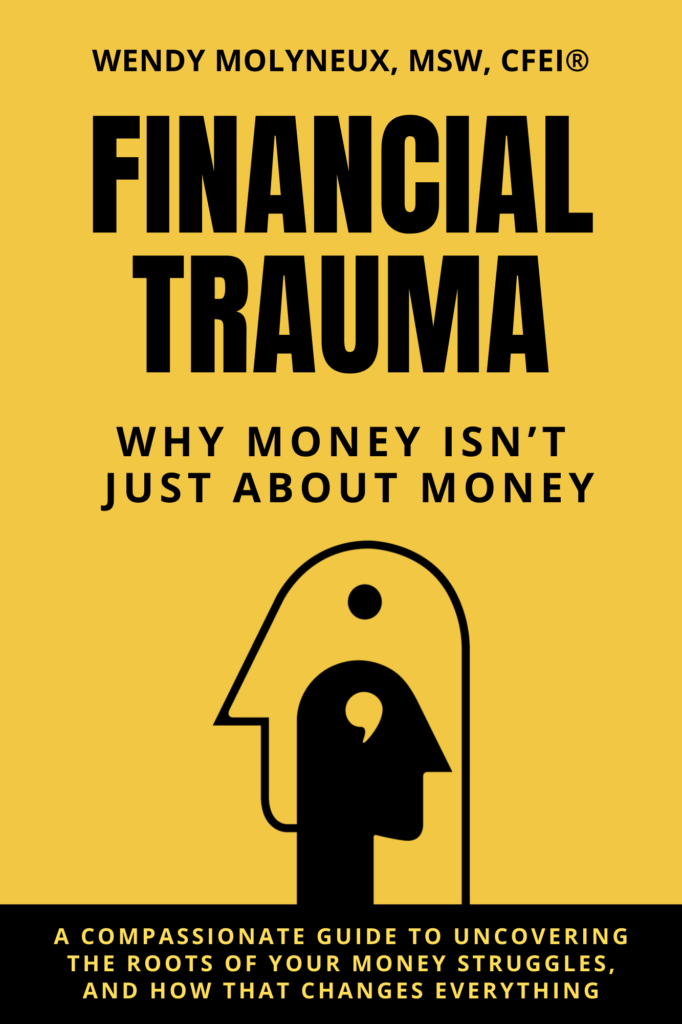
Official book cover for media reference.
Media Credits and Use
The material on this page is available for use only by credentialed journalists from established media sources. Use of this content requires proper attribution to Wendy Molyneux, MSW, CFEI® as the original author. To provide readers with full resources, a backlink to WholePerson.finance is appreciated.
Inquiries: Wendy is available for inquiries and interviews; media inquiries are typically addressed within 24 hours. Book or contact here.
Note: This content is for educational purposes only and does not constitute professional financial, medical, or mental health advice.