The Financial Wellness Ecosystem™
Why Financial Advice Fails When It Ignores the Nervous System, Emotions, Relationships, and Identity
By Wendy Molyneux, MSW, CFEI®, wholeperson.finance
Core Insight: Financial health isn’t a math or willpower issue; it’s a biological, psychological, social, and meaning-making system. By applying the biopsychosocial-spiritual model and the Eight Dimensions of Wellness, we move beyond “discipline” to address the true drivers of financial behavior.
Suggested Quote: “Financial behavior doesn’t happen in isolation. The nervous system shapes risk tolerance. Social systems impact opportunity. Identity and purpose affect how we define “enough.” To understand the bank account, we must first know the whole person.”
My work draws from the biopsychosocial-spiritual model, noted by Mary Richmond and popularized by George L. Engel and widely adopted in social work and health care. The model recognizes that human experience unfolds across biology, psychology, social systems, and meaning. When applied to money, it challenges a narrow focus on budgets and balances.
Financial behavior doesn’t happen in isolation. The nervous system shapes risk tolerance. Attachment patterns influence spending and saving. Social systems constrain opportunity. Identity and purpose affect how we define “enough.” When financial advice ignores these dimensions, it often fails, not because people lack discipline, but because the framework is incomplete.
I also use the Eight Dimensions of Wellness—emotional, environmental, financial, intellectual, occupational, physical, social, and spiritual—as an analytic lens. Originally developed for behavioral health settings, the framework translates seamlessly into financial well-being. Instability in one dimension rarely stays contained. Financial stress can disturb sleep, strain relationships, cloud decision-making, and erode a sense of safety. Likewise, improvements in one area often strengthen others.
To make this interconnected system visible, I developed the The Financial Wellness Ecosystem™, a visual dashboard tool that offers a snapshot of where someone is thriving and where attention may be needed. The dashboard appears in my book Financial Trauma: Why Money Isn’t Just About Money (p. 67), along with reflective prompts for each dimension.
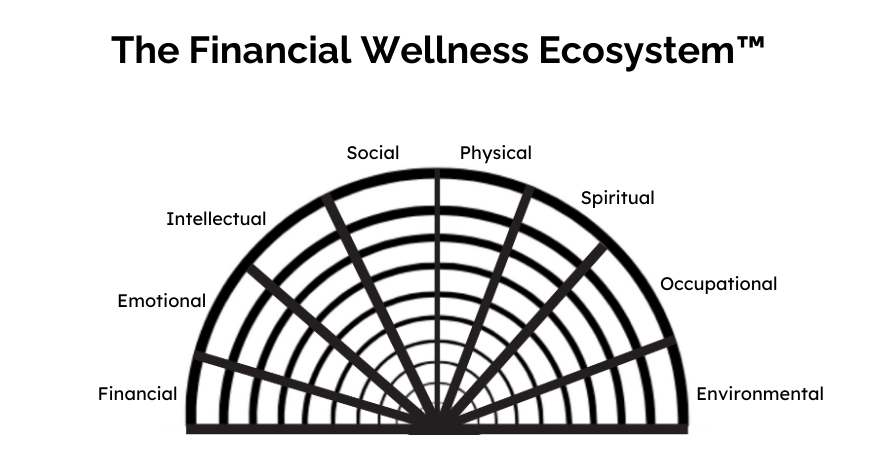
The goal is not perfection across every category in a holistic framework. It’s awareness. It’s choosing one doorway. One area where change feels possible. Because when one dimension shifts, the whole system responds.
Media Credits and Use:
The material on this page is available for use only by credentialed journalists from established media sources. Use of this content requires proper attribution to Wendy Molyneux, MSW, CFEI® as the original author. To provide readers with full resources, a backlink to WholePerson.finance is appreciated. Wendy is available for inquiries and interviews; media inquiries are typically addressed within 24 hours. Book or contact here.
Licensing & Professional Use:
The frameworks and models on this site are proprietary intellectual property developed by Wendy Molyneux, MSW, CFEI®. While this content is made available here for journalistic reference, professional use—including training, curriculum development, clinical application, or organizational programming—requires a licensing agreement or formal collaboration. If you’re a therapist, educator, or organization interested in bringing this work to the people you serve, I’d love to explore what that might look like. Reach out here.
Note: This content is for educational purposes only and does not constitute professional financial, medical, or mental health advice.